If you have done everything right — worked hard, mastered your craft, and led with absolute honesty — yet still feel an undeniable ceiling on your growth, you are not alone. Money & Morals is a free platform built for value-driven leaders who refuse to compromise their integrity on the way to the top. Whether you are a startup founder, a seasoned entrepreneur, or a veteran of your industry, you will find hundreds of free resources updated daily — including legal forms and contracts, business and wealth-building strategies, motivational stories, and practical tools designed to help you reach the level of success you desire and deserve. This platform was created by highly accomplished entrepreneurs and industry leaders who are devoted to helping those committed to maintaining the highest of standards — no pitches, no upsells, and no hidden agendas, just free value adds. Simply complete our ethical questionnaire, and if your values meet the standard, everything here is yours. Free. Without compromise.
Our standards are derived from a belief in higher principles than those of civil values alone and reflect how we should treat one another in all facets of life.
We also believe that in order to create a more honest business society and to promote trust between corporations and consumers, we cannot simply rely on society's laws to dictate how we should behave and conduct business. We must seek out and develop the habit of doing what is right, not just what is legal.
The Hidden Game
Competition can be healthy — in sports, it sharpens performance and elevates everyone. In business, however, most competition is rooted in scarcity. Those who reach the top often refuse to share what got them there, viewing those coming up as rivals rather than collaborators. But the belief that sharing your knowledge diminishes your own success is a fundamental misunderstanding of how abundance works. The universe does not run out. When value is given freely, it multiplies — it does not deplete. It is time to replace the scarcity and competition mindset with one of thriving, abundance, and collaboration. And even when the determined few manage to piece together fragments of the formula on their own, most people never gain access to the complete roadmap — and that gap makes all the difference.
Suppose you were invited to a friend's house to play a board game. A fellow guest teaches you six rules. You nod, confident you understand. But unbeknownst to you, there are actually twenty-six rules to this game.
"How often would you win? You would lose, and you would lose repeatedly — not because you lacked intelligence or talent, but because you were never given the complete playbook."
This is precisely how real business and macroeconomics operate. Most well-intentioned entrepreneurs are running their operations, their families, and their futures while possessing only a fraction of the necessary rules of engagement. They are being dominated by players who are not inherently smarter or more capable — but who simply understand the actual rules of the financial game.
The Grandmaster Principle
Imagine a grandmaster chess player who has gone decades without a single loss — not because the opposition is weak, but because he understands chess at a global, multi-dimensional level. What would happen if you entered him into a regional tournament?
Relies on surface-level tactics, conventional moves, and merely a handful of the rules handed down by traditional systems. Competes on effort, charisma, and product quality alone. Perpetually confused by moves that seem to defy the guidelines they were given.
Operates with the complete playbook of generational wealth applied to every local market they enter. Does not simply compete — he systematically dominates, because the vast majority of competitors are relying on outdated, surface-level tactics.
"When you learn the highest principles of business and understand how capital flows at a global scale, and you apply those exact laws to a regional business or local enterprise, you will dominate your market — especially if you maintain a high standard of ethics and integrity."
The Moral Philosophy
It is common to hear good-hearted, ethical leaders say: "I don't really desire to make generational wealth. I just want enough to take care of my family and keep my bills paid." There is an undeniable, superficial attraction to this minimalist sentiment. It sounds humble. It sounds noble. But examine it through the lens of true moral philosophy and global impact.
If you possess the latent potential to impact tens of thousands or even millions of lives through philanthropic endeavors, clean water initiatives, medical advancements, or economic empowerment, but you choose to play small because you "don't need much," that is not humility.
One could conclude that it is a deeply selfish way to look at wealth.
If every brilliant, honest, and high-integrity person on earth adopted a minimalist financial mindset, there would be no capital available to fund major foundations, establish medical research institutes, or rescue communities from structural poverty. Millions of people would be left completely exposed because those with the highest morals refused to master the skill of money.
"Wealth creation must remain a critical objective on your primary hand of priorities, because without it, your grandest visions for global good remain nothing more than empty promises on a screen."
Structural Integrity
When we discuss integrity in everyday conversation, we think of the moral definition: being honest, keeping your word, executing business ethically. This is foundational. But there is an entirely separate definition used by engineers and architects that most leaders have never considered.
Honesty. Transparency. Keeping your word. Executing business with absolute ethics. This is the foundation without which no real wealth should ever be built. You likely already possess this in full.
When an engineer evaluates a skyscraper and asks "what is the integrity of this building," they are asking if it is perfectly aligned and completely congruent in its building materials — whether the materials and engineering codes match the environmental stress the structure will face. Partial alignment means collapse when the real storm hits.
Today, social media is flooded with founders, coaches, and creators selling a beautiful narrative. They post about changing the world, disrupting entire industries, and positively impacting millions. Yet when you look closely at the actual operational mechanics they execute on a weekly basis, none of their actions are engineered to produce a massive increase in their wealth position. They are so intoxicated by the cause that they have spent zero time getting exceptionally good at monetization.
The Incongruency Trap
If your stated vision requires millions of dollars to fund, protect, and scale, but your daily business model is only designed to yield a modest personal income, you are suffering from a severe structural integrity issue. Your actions do not match your claims. To serve at your highest level, you must possess the courage to focus intensely on monetization. Getting great at the wealth side of business is not a betrayal of your morals — it is the ultimate fulfillment of them.
Proof of Principle
Most people understand integrity as a moral virtue. Fewer understand it as the most powerful financial instrument in existence. This is what that looks like in practice.
Marcus Webb had spent seven years as a commercial real estate broker — grinding through deals, surviving on commission alone. Three days before the largest closing of his career — a $47 million commercial property sale — he found something buried in a 2009 environmental assessment. A soil contamination report. A chemical plume. Partially remediated. Never officially closed.
His attorney said it wasn't his obligation to disclose. His managing broker told him not to touch it. His accountant reminded him the commission was $94,000. Everyone agreed: not his problem, not his deal, not his responsibility.
But he knew.
The deal collapsed in 48 hours.
What followed was brutal. His managing broker stopped putting him on good listings. He lost the commission. He nearly lost his job. He had traded $94,000 for a reputation he couldn't deposit.
Eight months later, David Chen was promoted to Chief Real Estate Officer of a $4.2 billion institution with 200 branches and a decade-long expansion plan. His first outside call was to Marcus Webb.
Over the next six years, Marcus Webb's firm handled $340 million in acquisitions for that single institution alone. He hired four brokers, opened a second office, and moved from commissions to retained advisory fees — income that arrived whether deals closed or not.
"A commission is forgotten the moment it clears. A reputation built on one honest call echoes for decades."
Every ethical decision you make is a deposit into an account that cannot be taxed, seized, or inflated away. Your reputation arrives in every room before you do — it signs every contract before your pen touches paper, and it opens doors that money alone cannot unlock. Marcus Webb didn't choose integrity over profit. He discovered what every serious operator eventually learns: over time, they are the same thing.
The Disparaging Gap
Most well-meaning people operate under a deeply flawed institutional misconception — they believe that earning an extraordinary amount of money is directly tied to their intrinsic human value or the excellence of their work. The hard mechanical reality of economics is that your product value, service transformation, personal ethics, and team dedication will never automatically ensure you make more than just a decent living.
"Making money is not a reflection of your worth as a human being; it is a mechanical skillset that must be deliberately studied, practiced, and mastered."
People either took the time to learn how to play a musical instrument, or they didn't. Someone may have taken the time to learn a second language, or they will never be bilingual. In precisely the same way, entrepreneurs were either explicitly taught the macro-strategies of high-leverage wealth creation, or they weren't. Closing this gap isn't about working more hours or sacrificing your soul. It is about acquiring one premium skill set: the skill of scaling your value, positioning your genius, and pricing your offerings in absolute alignment with the magnitude of the problems you solve.
The Private Network
There exists a real, highly coordinated group of individuals worldwide who control vast financial resources, generating billions of dollars in economic velocity. Unlike the stereotypical figures portrayed in media, this private ecosystem does not operate on greed, ruthless exploitation, or moral compromise.
"This private community functions on a strict, unbreakable code of absolute ethics, transparent honor, and structural congruence. They understand that money is nothing more than a supreme magnifier."
Placed into the hands of someone insecure, greedy, and morally bankrupt, wealth magnifies those vices — making them a destructive and destabilizing force in society.
Placed into the hands of someone pure of heart, deeply principled, and dedicated to human flourishing, massive capital magnifies their capacity for good — turning them into a monumental force for global transformation.
The sovereign strategies that allow a business to scale rapidly, capture immense market share, and command massive liquid reserves are deliberately protected. They are shared exclusively with those who are malleable, highly values-driven, and possess unshakeable personal character. This private network actively routes capital through trusted, high-integrity nodes — building empires, executing joint ventures, and moving billions of dollars across industries for one unified purpose: to generate the massive pools of capital required to fund real, sustainable, and permanent global impact.
They are the architects of change, operating quietly behind the scenes, ensuring that wealth is continually repurposed for the elevation of humanity. And right now, they are looking for the next generation of leaders who are ready to close their Disparaging Gap and enter the arena.
A Moral Imperative
There is nothing noble about remaining underpaid when the work you do is genuinely transformational. There is nothing ethical about choosing to play a small, comfortable game when thousands of people are waiting on your resources to help them rise. To serve your communities at the absolute highest level, you must possess the courage to receive at a matching scale.
What if you dedicated just twelve focused months to mastering the high-leverage rules of global wealth creation? Even if you only closed your Disparaging Gap by a conservative 50% — what would your new financial number look like? More importantly, how much capital would suddenly be unlocked to fund the charities, the movements, and the world-changing initiatives that you were uniquely put on this earth to pioneer?
Begin Your Journey →Your Next Step
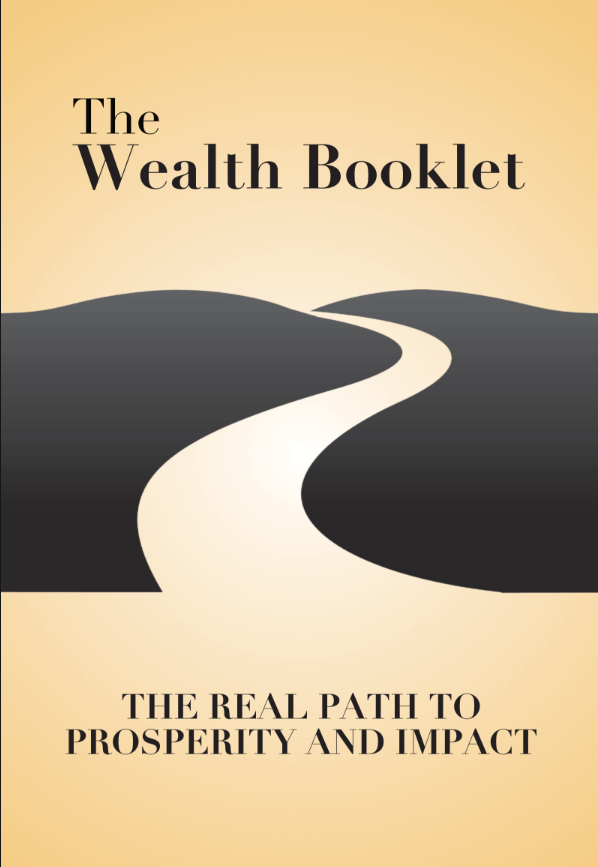
Claim your completely free copy of this valuable resource — a masterclass in print to begin closing your Disparaging Gap today.
Regardless of whether you choose to join us, consider this our complimentary gift to you — offered freely and without condition. The Wealth Booklet will provide the first steps to help you uncover the exact strategic differences between merely making a good living and engineering a self-sustaining financial empire built on honesty, transparency, and global stewardship. We trust it will serve you well.